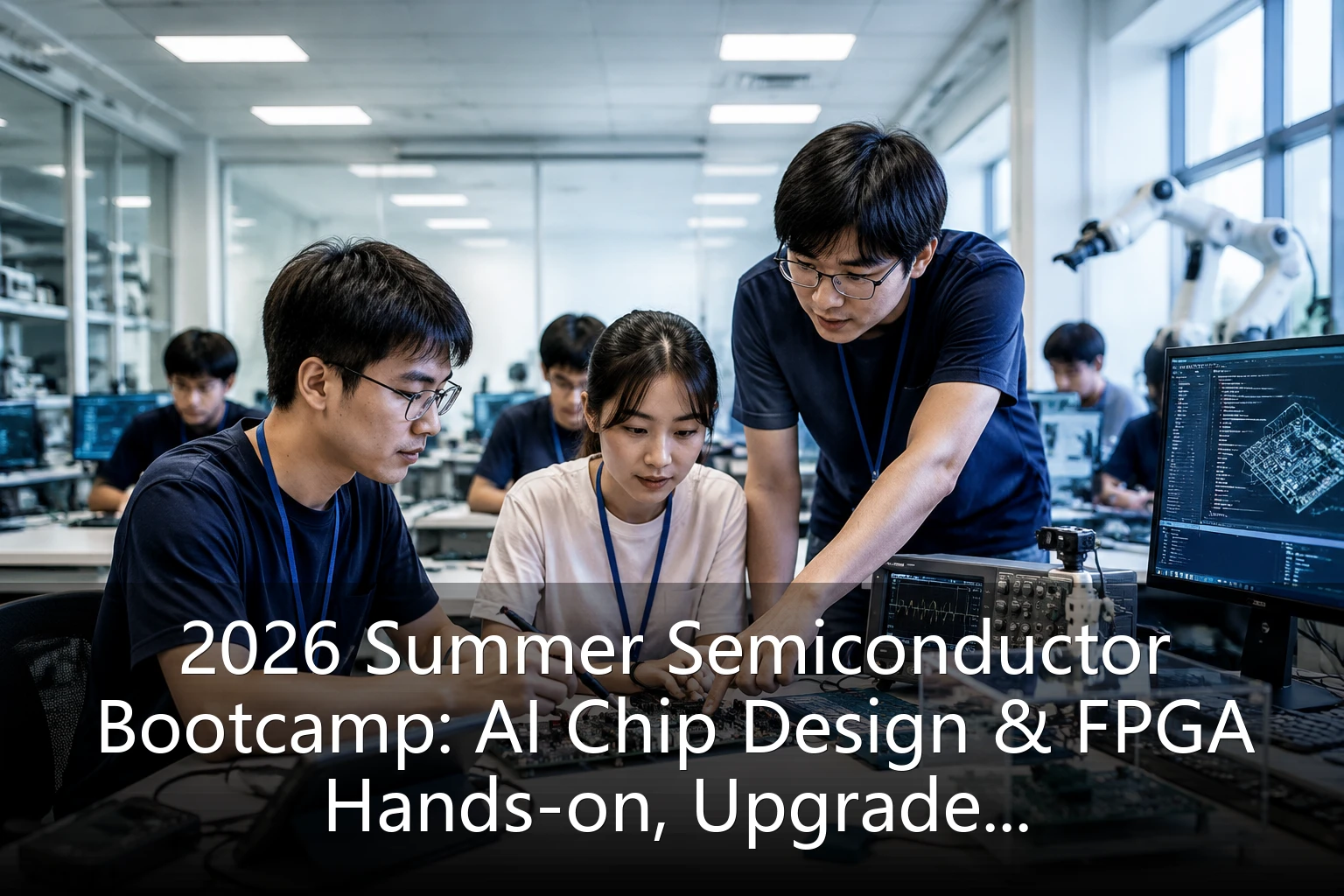
As the global semiconductor industry continues to heat up, especially with the explosive growth in demand for AI chips, how to quickly cultivate engineers with hands-on capabilities has become a focus for countries. In the summer of 2026, the "International Semiconductor Bootcamp" organized by the Taiwan Semiconductor Industry Association (TSIA) and co-hosted by TSMC, MediaTek and other major companies officially launched, attracting over 300 participants from around the world. Unlike traditional theoretical classes, this bootcamp focuses on "AI chip design" and "field-programmable gate array (FPGA) implementation" as its dual core, aiming to bridge the gap between academia and industry.
Course Design: Full Coverage from RTL to Chip Testing
The bootcamp lasts four weeks and is divided into two phases: foundation consolidation and project implementation. The first week focuses on digital IC design basics, including Verilog hardware description language, logic synthesis, and timing analysis, taught by senior engineers from MediaTek. From the second week onward, participants engage in FPGA development board implementation, using the latest Xilinx and Altera platforms to complete the full process from RTL design, simulation verification, to board-level debugging. Notably, a new "AI Accelerator Design" module has been added this year, where participants must implement a lightweight convolutional neural network accelerator on FPGA and evaluate performance and power consumption.
"In the past, students only ran simulations in EDA tools; now they directly program FPGAs, see waveforms and actual signals, and the understanding is completely different," said Professor Lin Zhengxiong, convener of the bootcamp and professor of electrical engineering at National Tsing Hua University. In the third and fourth weeks, participants enter group projects with topics including low-power IoT chips, edge AI inference engines, 5G baseband processors, etc., with process libraries and design kits provided by TSMC's design services division, allowing participants to experience considerations from design to mass production.
Industry-Academia Collaboration: Corporate Mentors and Internship Pathways
The biggest highlight of this bootcamp is the "one-on-one corporate mentor system." Each participant is paired with an industry mentor from MediaTek, Realtek, or TSMC, with two technical discussions per week and feedback on project progress. Outstanding performers can directly receive corporate internship interview opportunities. "AI chip design requires cross-disciplinary skills. We are very willing to give priority admission to students selected through the bootcamp," said Chen Yijun, deputy general manager of human resources at MediaTek.
In addition, TSMC opened its 3nm process design kit (PDK) for participants to use. Although they cannot actually tape out, they can verify designs through a simulation environment, something previously limited to internal engineers. "We hope that through the bootcamp, young engineers can become familiar with advanced process constraints in advance, accelerating innovation implementation," said Sun Yuancheng, CTO of TSMC.
Participant Feedback: A Key Step from Theory to Practice
Participant Wang from Nanyang Technological University in Singapore shared, "School courses taught many algorithms, but I never knew how to convert them into hardware circuits. At the bootcamp, I implemented a simple YOLO object detector on FPGA. Although it only achieved a few frames per second, seeing the result gave me a great sense of achievement." Another participant, Li, a doctoral student in electronics at National Taiwan University, said, "I encountered a timing closure problem in the project. My mentor directly helped me capture signals with a physical oscilloscope. This kind of experience cannot be learned from textbooks."
The bootcamp also attracted many in-service industry professionals. Engineer Zhang, who works at an IC design company, said, "Our company is introducing AI-related chips, but I was not familiar with FPGA prototyping verification. These weeks of courses helped me fill the key skills gap." The organizers revealed that the proportion of corporate participants reached 15% this year, doubling from last year.
Industry Significance: An Accelerator to Alleviate the AI Chip Talent Shortage
According to the 2026 report from SEMI, the global semiconductor talent gap remains at 200,000 people, with AI chip design-related positions growing the fastest. Traditional university education often lags behind industry needs by 2-3 years, and short-term intensive training like this bootcamp helps fill the gap. "We plan to standardize this model and promote it to Southeast Asia and Europe in the future, building a global semiconductor talent pool," said Lu Chaoqun, chairman of TSIA.
Notably, this bootcamp also introduced a "Design Thinking" workshop, co-organized by the NTU Innovation and Design Institute, requiring participants to define chip specifications from user needs. Industry analysts believe that such cross-domain training can cultivate engineers who understand the market, avoiding the disconnect between technology and business.
Future Outlook: Blended Online-Offline Model and Certification
The organizers announced that from 2027, the bootcamp will launch an online essence version, allowing participants who cannot attend in person to join some courses. At the same time, it is collaborating with the Global Semiconductor Alliance (GSA) to plan a "Semiconductor Hands-on Competency Certification" system, where those who pass the practical test will receive an industry-recognized certificate, further enhancing the training value.
At a critical moment of global semiconductor supply chain restructuring, Taiwan's bootcamp model not only strengthens its own talent resilience but also injects new momentum into global technology competition. As a TSMC mentor said, "True chip design capability is tempered through repeated debugging and burn-in tests."