ECB Hawkish Signal: Rising Rate Hike Probability After Summer, Inflation Control Enters Critical Phase
Keywords
European Central Bank, Schnabel, rate hike, inflation, energy prices, geopolitics, second-round effects, monetary policy
Introduction
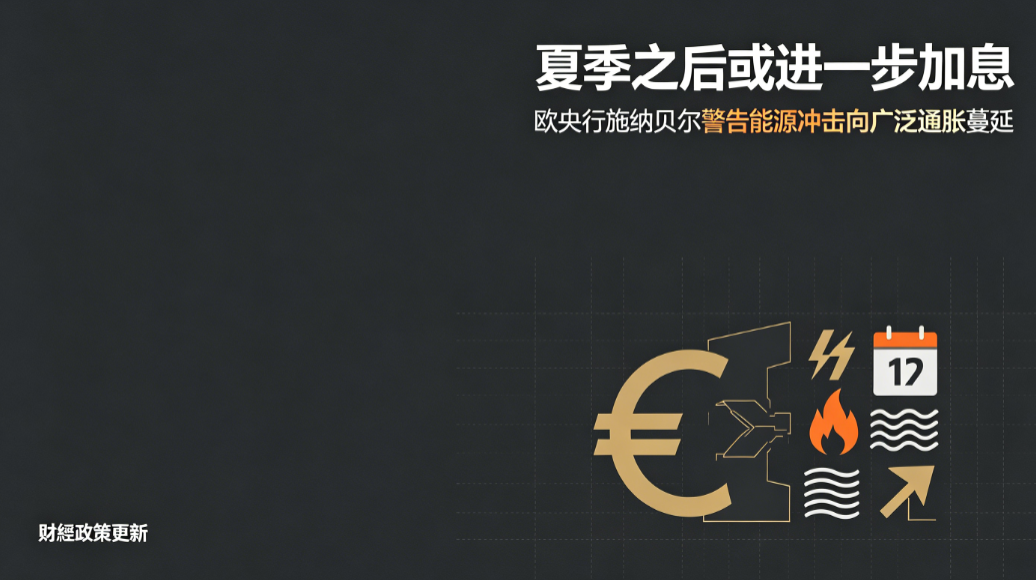
Against the backdrop of uneven global economic recovery and ongoing geopolitical risks, the direction of ECB monetary policy is attracting market attention. Recently, ECB Executive Board member Isabel·Schnabel delivered a clear signal in a public speech: the eurozone may need to further raise interest rates after summer to ensure the medium-term inflation rate returns to the 2% target. This statement not only dashed market expectations of rate cuts this year but also highlighted the ECB's firm stance in fighting inflation. Schnabel's remarks reflect the complex economic picture facing the eurozone—high energy costs, increasing core inflation stickiness, and unresolved geopolitical risks, which together constitute core variables in the ECB's decision-making framework.
Rate Hike Path Not Over: Room for Further Increases After Summer
Schnabel clearly stated that based on the current economic situation, the eurozone may need to further raise interest rates after summer. This judgment is sharply different from the market's previous general expectation that “rate hikes are nearing an end.” She emphasized that the pace and magnitude of future monetary policy adjustments will strictly depend on three key factors: the evolution of geopolitical tensions in the Middle East, changes in eurozone economic growth momentum, and the actual trend of subsequent inflation data.
From current data, the overall eurozone inflation rate has declined, but core inflation remains elevated and service price increases remain persistent. Schnabel's remarks indicate that the ECB is cautious about the claim that “inflation has peaked” and is more inclined to view the current pullback as a temporary phenomenon rather than a trend reversal. In her view, to achieve the medium-term inflation target of 2%, policy continuity and sufficient strength must be maintained until inflation expectations are firmly anchored.
Geopolitical and Energy Risks: Short-Term Improvement Cannot Mask Long-Term Concerns
Despite the recent US-Iran memorandum of understanding and the drop in international oil prices improving short-term prospects, Schnabel believes this does not constitute a reason for a policy shift. She pointed out that current energy prices are still above pre-conflict levels and long-term energy contracts also show that cost pressures will persist. This assertion is based on a multi-dimensional risk analysis:
First, the risk of shipping disruptions in the Strait of Hormuz has not been eliminated. As one of the world's most important oil transport chokepoints, any unexpected event in the Strait of Hormuz could trigger sharp oil price volatility. Rising insurance costs and the possibility of damage to energy infrastructure have significantly increased the vulnerability of energy supply chains. Second, Europe's need to replenish strategic reserves and gas storage before winter will further support high energy costs. Even with a temporary drop in oil prices, Europe's strategic gas restocking demand will keep prices at elevated levels.
Schnabel's view clearly indicates that the ECB cannot let its guard down just because of a short-term drop in oil prices. The “normality” of rising geopolitical risks means that energy price volatility may become a structural feature for years to come, and monetary policy must seek certainty amid uncertainty.
Second-Round Inflation Effects: Core Inflation Stickiness Becomes the Biggest Threat
More critically, the ECB's concern about “second-round inflation effects” is intensifying. Schnabel revealed that the initial energy price shock has spread to broader inflation areas, with non-energy goods and services showing upward price pressure, and companies gradually passing on increased input costs to end consumers. This trend increases the risk of high inflation eventually transmitting to wage negotiations, although there are no signs of significant wage growth acceleration yet.
The so-called “second-round effect” refers to the process where the initial energy price shock is transmitted through the production chain to other goods and services, thereby pushing up the overall price level. Once companies generally form the expectation that “costs will permanently rise,” they will preemptively incorporate this factor into pricing, thus forming a vicious cycle of wage-price spiral. Schnabel's speech is precisely a warning against this risk: the ECB cannot sit by and let the energy shock evolve into a full-blown entrenchment of inflation.
From the data, eurozone services inflation continues to be higher than pre-pandemic levels, with cost pressures in housing, transportation, and dining still accumulating. If the second-round effects truly materialize, the ECB will have to adopt stronger tightening measures, and this is the fundamental reason why Schnabel emphasized that “further rate hikes may occur after summer.”
Monetary Policy Restrictiveness: Current Rates Far from Adequate
In response to external discussions that monetary policy has become restrictive, Schnabel explicitly refuted. She stated that even under a mild scenario of rapid oil price normalization, the recent rate hikes are still appropriate, with the core purpose being to prevent temporary energy shocks from taking root in medium-term inflation expectations. In her view, the current interest rate level has not yet reached a restrictive degree sufficient to significantly curb aggregate demand.
This view contrasts sharply with mainstream market judgment. Some analysts believe that the ECB has raised rates multiple times and the policy rate is close to neutral, so further rate hikes could harm the economic recovery. But Schnabel, from the perspective of inflation expectations, emphasizes the need for “preventive rate hikes”: if a sufficiently strong stance is not taken now, once inflation expectations become unanchored, the future cost of control will multiply. She specifically pointed out that even if energy prices return to normal, if companies and consumers permanently change their sensitivity to inflation, monetary policy will still need to keep exerting pressure.
Hawkish Stance Continues: Market Should Prepare for Rate Hike Resumption
As a member of the ECB Governing Council with a relatively hawkish stance, Schnabel's latest remarks send a clear signal: until inflation data confirms a downward trend, the ECB will maintain its tightening bias to address the structural risk of energy shocks transmitting to core inflation. Market analysts believe that if subsequent data show increasing stickiness in non-energy inflation or wage growth exceeding expectations, the probability of the ECB resuming rate hikes in the second half of the year will further increase.
From a broader perspective, the ECB's policy dilemma is that the inflation target has not yet been achieved, while economic growth is showing signs of weakness. How to balance curbing inflation and avoiding a recession tests the wisdom of policymakers. Schnabel's hawkish stance indicates that, at least at this stage, the ECB prioritizes “inflation stability.” This means that even if economic data fluctuates, as long as inflation pressures are not substantially alleviated, the door for rate hikes will not close.
Conclusion
Overall, the ECB is at a critical turning point in fighting inflation. Schnabel's speech is both a release of policy signals and a correction of market expectations. Investors and policymakers need to clearly recognize that high energy costs, the long-tail effects of geopolitical risks, and the potential threat of second-round inflation effects could make the eurozone's path to inflation control longer and more difficult than expected. In this context, the possibility of further rate hikes after summer cannot be ignored, and the ECB's determination to maintain a tightening bias will continue to influence global asset pricing and economic prospects in the coming months.