
The Light of Glass: Corning's Optical Interconnect Innovation and the New Era of AI Data Centers
Abstract
With the explosive growth of AI applications, data centers have unprecedented requirements for data transmission bandwidth and energy efficiency. Optical interconnect technology, as a key path to break through the bottleneck of electrical interconnects, is entering an important window for technological innovation. On June 24, 2024, at the “AI Data Center Optical Communication Interconnect Technology Conference” held in Seoul, South Korea, Corning publicly disclosed multiple optical interconnect architectures, technologies, and products closely related to co-packaged optics and glass substrates, including the glass-based optical interconnect technology “GlassBridge”, the next-generation CPO architecture, and the GlassWorks AI platform. These technological breakthroughs not only demonstrate the great potential of glass materials in the field of optical communication but also point a new direction for the development of AI data centers. This article will deeply explore the core principles, industrial value, and far-reaching impact of Corning's technological innovations on future data center architecture.
I. Introduction: Optical Interconnect Challenges in the AI Era
Against the backdrop of exponential growth in AI computing power demands, data transmission within data centers faces unprecedented challenges. Traditional electrical interconnect technology is constrained by multiple limitations such as signal attenuation, crosstalk, and power consumption, making it difficult to meet the demands of high-bandwidth, low-latency applications. Particularly during deep learning model training and inference, large amounts of data need to flow rapidly among compute nodes, storage devices, and networks, placing higher requirements on interconnect technology.
Optical interconnect technology, with its advantages of high bandwidth, low power consumption, and immunity to electromagnetic interference, is regarded as the most promising solution to break through the bottleneck of electrical interconnects. However, the application of optical interconnect technology also faces challenges such as high precision requirements for optical alignment, high manufacturing costs, and difficulties in integration with existing electronic devices. It is against this backdrop of technological evolution that Corning, leveraging its deep accumulation in glass materials and optics, has launched a series of innovative optical interconnect solutions, injecting new momentum into the development of AI data centers.
II. GlassBridge Technology: A New Paradigm for Optical Interconnect
2.1 Technical Principles and Innovations
The “GlassBridge” technology disclosed by Corning at this conference represents a major breakthrough in the field of optical interconnects. GlassBridge is an optical connector made of glass, whose core function is to achieve direct connection between optical chips and optical fibers. The uniqueness of this technology lies in its use of optical waveguides built inside the glass as signal transmission channels, fabricating nanometer-scale optical waveguide structures on a glass substrate through precision ion-exchange waveguide technology.
The main technical challenge of this innovation lies in the size adaptation problem. The core diameter of traditional optical fibers is typically on the order of several micrometers, while the optical waveguide dimensions inside GlassBridge are only a few hundred nanometers, resulting in a size difference of more than ten times. To overcome this obstacle, Corning adopted wafer-based ion-exchange waveguide technology, precisely controlling the ion diffusion process to construct waveguide structures inside the glass that can efficiently transmit optical signals.
2.2 Technical Advantages and Application Prospects
The biggest advantage of GlassBridge technology is that it simplifies the alignment and assembly process between optical fibers and optical chips. In traditional optical interconnect solutions, the design of optical modules usually requires complex fiber array units for signal coupling, which not only increases device size but also raises manufacturing costs. GlassBridge technology, by directly constructing waveguide structures on a glass substrate, achieves direct and efficient transmission of optical signals between fibers and chips, eliminating the need for traditional pluggable optical modules or long fiber array units.
Currently, Corning is jointly developing GlassBridge technology with multiple partners, with the goal of controlling the coupling loss between fibers and optical chips below 2dB. According to the plan, the first batch of products will support application scenarios with a core pitch of 30 micrometers or more. This technical indicator is of great significance for practical applications, as lower coupling loss means higher system energy efficiency and longer transmission distances, while smaller pitch facilitates high-density optical interconnects. Although Corning had already mentioned GlassBridge technology on social platforms and its official website as early as February this year, it did not attract widespread market attention at that time. It was not until this conference, with the rapid rise in interest in glass substrates within the industry, that this technology truly drew external attention.
III. The Glass Substrate Revolution in CPO Architecture
3.1 Design Concept of the Next-Generation CPO Architecture
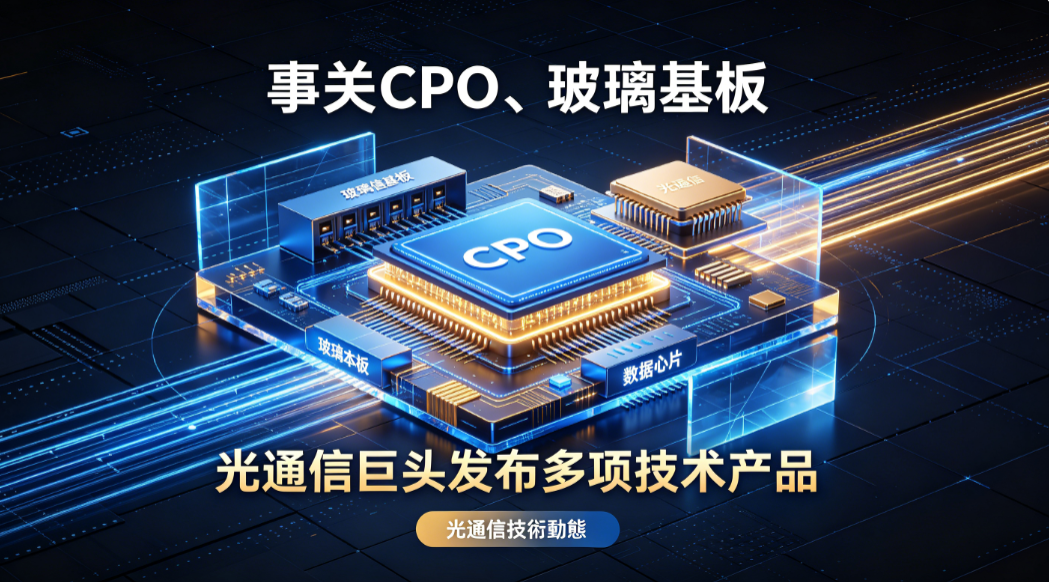
Co-packaged optics technology is one of the most important technological directions in the field of optical interconnects in recent years. Its core concept is to integrate optical modules and switch chips into the same package, minimizing the signal transmission distance between optical circuits and electrical circuits, thereby reducing power consumption, decreasing latency, and increasing bandwidth density.
The next-generation CPO architecture disclosed by Corning at this conference further deeply integrates glass substrates with optical interconnect technology. This architecture adopts through-glass via technology to directly construct optical waveguides on a glass substrate and mounts optical chips using flip-chip methods. This design not only fully utilizes the excellent optical properties of glass materials but also leverages their good thermal stability and dimensional stability, providing an ideal substrate material for high-precision optical assembly.
3.2 The Key Role of TGV Technology
TGV technology plays a core role in the glass substrate CPO architecture. By creating vertical through-holes in the glass substrate, TGV achieves efficient transmission of optical signals between different layers of the glass substrate. Compared with traditional silicon substrates, glass substrates offer better optical transparency, lower high-frequency loss, and superior insulation properties, making them an ideal choice for optical interconnect applications.
Corning's architectural design aims to meet the expanding demand for glass substrate semiconductor packaging in the future. As AI applications continue to drive demand for computing and communication bandwidth, glass substrates, with their unique performance advantages, are gradually expanding from traditional display and packaging fields into higher-end optoelectronic integration areas. Corning's long-term accumulation and continuous innovation in glass materials have positioned it favorably in this transformation process.
IV. GlassWorks AI Platform: Building a Complete Solution
4.1 Platform Architecture and Functions
To support the optical interconnect needs of AI data centers, Corning has launched the GlassWorks AI platform for data centers. This platform aims to provide complete co-packaged optics solutions, covering the construction of optical communication infrastructure from within data centers to between data centers. The platform's product range is extremely broad, including optical fibers, cables, connectors, fiber array units, and various alignment components.
The launch of the GlassWorks AI platform reflects Corning's strategic transformation from a single component supplier to a complete solution provider in the optical communication field. By integrating a full product line from basic optical materials to system-level solutions, Corning can offer its customers one-stop services, simplify supply chain management, and shorten product time-to-market.
4.2 Impact on Data Center Architecture
The GlassWorks AI platform has profound implications for future data center architecture. As AI applications continue to increase demands on computing performance and communication bandwidth, traditional data center network architectures are becoming increasingly complex and expensive. By providing standardized, integrated optical interconnect solutions, Corning's GlassWorks AI platform is expected to significantly reduce data center construction and operating costs while improving overall system performance and reliability.
Specifically, the GlassWorks AI platform mainly supports the following aspects: first, high-speed interconnects within high-performance computing clusters; second, data transmission between different racks and cabinets in data centers; and finally, remote connections across data centers. Through these comprehensive supports, Corning hopes to promote the extension of optical interconnect technology from traditional backbone network applications to edge applications within data centers, achieving full popularization of optical interconnect technology.
V. Industry Impact and Future Outlook
5.1 Reshaping the Pattern of the Device Industry
Corning's series of technological innovations in the field of optical interconnects will have a profound impact on the device industry landscape. With the widespread application of glass substrate technology in CPO architectures, traditional optical module design and manufacturing methods will undergo significant changes. The commercial application of GlassBridge technology will further reduce the complexity of optical interconnect systems, increase integration, and thus drive the optical communication industry to a higher level.
5.2 Catalyzing the Industrial Ecosystem
Corning's GlassWorks AI platform is expected to become a catalyst for the development of the AI data center optical interconnect ecosystem. By providing complete solutions, Corning can lower the threshold for customers to adopt optical interconnect technology, promoting its application in a wider range of scenarios. At the same time, collaborative development with multiple partners will also promote the standardization and large-scale production of related technologies, laying the foundation for the healthy development of the entire industrial ecosystem.
VI. Conclusion
In an era where AI applications impose unprecedented demands on communication bandwidth and energy efficiency, Corning has opened new paths for the development of optical interconnects in AI data centers through a series of innovations including GlassBridge technology, next-generation CPO architecture, and the GlassWorks AI platform. These technologies not only demonstrate the huge application potential of glass materials in the optical communication field but also reflect Corning's strategic determination to transform from a component supplier to a complete solution provider.
In the future, with the further popularization of glass substrate technology in semiconductor packaging and the mature application of CPO architectures, Corning's innovations will have a profound impact on data center architecture design, the development of the optical communication industry, and the AI application ecosystem. We have reason to believe that, driven by companies like Corning, optical interconnect technology will play an increasingly important role in the AI era, providing more efficient and reliable communication infrastructure for human-computer information interaction.